What Is An EHCP? A Parent Friendly Guide
The first time somebody mentioned an EHCP to me, I remember sitting there nodding along as though I knew exactly what they were talking about. Inside my head though I was thinking, “What is an EHCP?” It felt like everybody around me knew what all these acronyms meant while I was desperately trying to keep up. I’d hear people talking about SEN, SEND, SENCOs and EHCPs as though they were everyday words, then I’d get home and spend half the evening Googling everything because I didn’t want to be that parent constantly asking people to explain things.
If that’s where you are right now then don’t worry because I think most parents start exactly the same way.
The problem is that when you search “what is an EHCP” you usually end up on pages full of legal jargon and official definitions that somehow manage to explain everything while also explaining absolutely nothing. They’re factually correct, but they don’t really tell you what an EHCP actually means when it’s your child who’s going through the process.
Having now been through it myself with Zak, I can honestly say an EHCP ended up being one of the most important things we’ve ever fought for. It didn’t magically solve every problem overnight because life doesn’t work like that, but it opened doors that simply weren’t there before and helped him move into a school where he’s genuinely happy, understood and able to be himself.
So, if you’re wondering what an EHCP is, who needs one and whether your child might benefit from one, I’ll explain it the way I wish somebody had explained it to me at the beginning. If you want the full step by step version, I’ve also written a complete EHCP guide for parents covering the whole process in more detail.
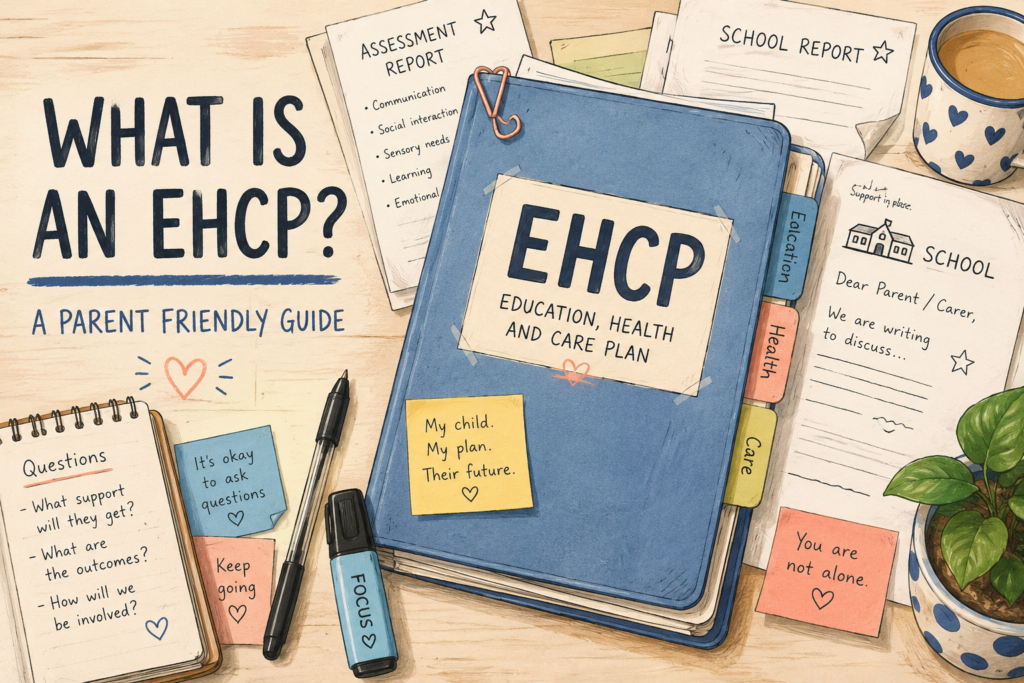
What Is An EHCP?
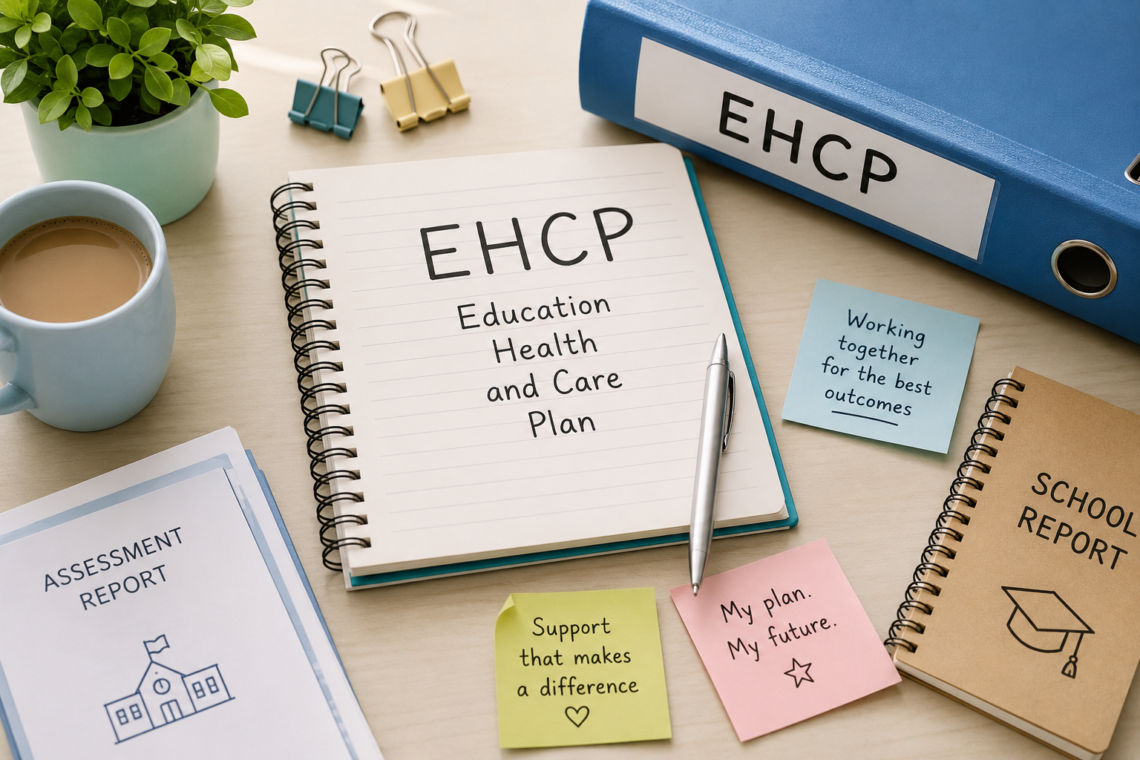
An EHCP stands for Education Health and Care Plan.
That’s the official definition anyway, but if you’d asked me what one was before we started this whole journey with Zak, I’d probably have just shrugged my shoulders because I genuinely hadn’t got a clue. It’s one of those things you don’t really hear about until somebody suggests your own child might need one, then suddenly it feels like everybody expects you to understand exactly how they work.
In simple terms, an EHCP is a legal document that sets out what support your child needs in education. The important word there is legal because that’s what makes it different from a lot of the support schools can already provide. Once an EHCP is in place, the support written into it isn’t just a suggestion or something that’s nice to have if there’s enough money or staff available. It’s something your local authority has a legal responsibility to provide.
I think that’s probably the bit that surprised me the most when I started learning about them because, if I’m honest, I thought an EHCP was just another report. I imagined it would be something that got written, filed away somewhere and then everybody carried on exactly as they had before. I couldn’t have been more wrong.
For us, Zak’s EHCP completely changed the direction of his education.
Before he moved to the school he’s in now, things were much more difficult. His primary school recognised he had additional needs and they genuinely tried to support him. He had quite a bit of one to one support and there were plenty of conversations between us and school about how they could help him. When he moved to secondary school we hoped things would get even better because they had an autism provision. Unfortunately it just wasn’t the right environment for him. He really struggled, ended up being suspended a few times because he couldn’t manage his needs in that setting and every meeting seemed to leave me feeling completely drained.
Fast forward to now and it’s like looking at a different child. He’s in a specialist setting where the staff genuinely understand autism and ADHD, the classes are much smaller and they don’t just see his diagnosis. They see Zak. They see how funny he is, how kind he is, how intelligent he is and they support him in a way that actually works for him instead of expecting him to fit into a system that clearly wasn’t working before.
Would that have happened without his EHCP? Maybe eventually, but I honestly don’t think it would have happened anywhere near as quickly, if at all.
That’s why I always tell people not to think of an EHCP as just another bit of paperwork because it’s so much more than that. Yes, you’ll probably end up with a folder full of forms, reports and letters by the time you’ve finished the process. I certainly did, and I still have them all now because you never know when you’ll need to look back at something. Underneath all of that paperwork though is one really important goal, and that’s making sure your child gets the education and support they need to reach their potential.
I also think it’s worth saying that an EHCP isn’t there because somebody thinks your child is failing or because you’ve somehow done something wrong as a parent. I know I carried a lot of guilt around after Zak’s autism diagnosis and I spent far too much time wondering if I’d missed something or could have done more. Looking back now I realise none of that was true. An EHCP isn’t about pointing out everything your child can’t do. It’s about recognising where they need extra support so they have the same opportunities as everybody else.
That’s probably the simplest way I can explain it. It isn’t a label. It isn’t a report telling people what’s wrong with your child. It’s a legal document designed to help them get the support they need to thrive in education and, from my own experience, it can make a much bigger difference than you might imagine when you’re first hearing those four letters for the first time.
Who Can Get An EHCP?
One thing I wish somebody had explained to me much earlier is that an EHCP isn’t awarded because your child has a diagnosis. It’s awarded because of the support they need. I genuinely thought everything depended on Zak’s autism diagnosis at first because that’s what everyone seemed to talk about. It was only once we’d started looking into the process properly that I realised it wasn’t as straightforward as that.
The easiest way I can explain it is this. Two children could both be autistic and have completely different experiences at school. One might be happy, making good progress and only need a few adjustments in the classroom. The other might be overwhelmed every single day, struggling to access lessons and needing support that the school simply can’t provide on its own. They both have the same diagnosis, but their needs are completely different. That’s why an EHCP looks at your child’s individual needs rather than the label they’ve been given.
That also means your child doesn’t have to have an autism or ADHD diagnosis before an EHCP assessment can even be considered. I think that’s something that catches a lot of parents out because it’s a really common misconception. If it’s already obvious that your child needs significantly more support than school can reasonably provide, you don’t necessarily have to wait until every assessment and diagnosis has been completed before asking questions about an EHCP.
I also think parents have a habit of talking themselves out of asking for help because we spend so much time comparing our children to everyone else. I know I did. You read stories online about children with much higher support needs and almost convince yourself that your own child isn’t struggling enough. The problem with that way of thinking is there’s always going to be somebody who’s having a harder time than you are, but that doesn’t mean your child doesn’t deserve support as well.
Instead of comparing your child to somebody else’s, I’d be asking different questions. Are they actually able to access education in the way they should be? Are they constantly overwhelmed at school? Is the support already in place no longer enough? Are they falling behind because their needs aren’t being met? Those are the questions that matter far more than whether somebody else’s child needs more or less support.
For us, things became much clearer as Zak got older. His primary school really did try. They recognised he had additional needs, he had one to one support and there was always communication between home and school about how things were going. It wasn’t perfect, but everybody was trying to help. Things changed when he moved to secondary school because, despite having an autism provision, it became obvious quite quickly that the environment just wasn’t right for him. He was overwhelmed, he was suspended a few times because he couldn’t cope with his needs in that setting and every meeting seemed to leave us feeling like we were taking one step forwards and two steps back.
Looking back now, that was probably the point where it became obvious that the support a mainstream school could reasonably provide wasn’t enough anymore. That’s exactly where an EHCP comes in. It’s there to recognise that some children need more specialised support to access education and to make sure that support is actually put in place.
If you’re reading this because you’re wondering whether your own child might need an EHCP, don’t make the mistake of ruling yourself out before you’ve even spoken to anybody. I nearly did that myself because I assumed there’d always be another child who needed one more than Zak did. Looking back now, I’m really glad we didn’t think like that because his EHCP has completely changed his education. If your instincts are telling you your child needs more support than they’re currently getting, they’re usually worth listening to.
What Does An EHCP Include?
Before we actually received Zak’s EHCP, I had this picture in my head that it’d be a couple of pages long with a few notes about him and a list of things school should probably try. That’s genuinely what I expected. Then it arrived and I realised just how much detail actually goes into one. At first glance it can look quite intimidating because there are so many different sections and plenty of terminology you’ve probably never come across before. I remember reading through ours thinking I’d have to go back and read it all again because there was so much information to take in.
An EHCP is designed to build a complete picture of your child, not just list their diagnosis. It looks at what they find difficult, what support they need, what everyone is working towards and how they’re going to be helped throughout their education. Every EHCP is different because every child is different, but there are a few things you’ll usually find in all of them.
You’ll normally see:
- Your child’s educational needs, including the things they struggle with in school.
- Any health needs that have an impact on their education.
- Social care needs, where they’re relevant.
- The support your child should receive and how often they should receive it.
- The outcomes everyone is working towards, both in the short and long term.
- The educational setting that’s considered the right place for your child.
I know that probably sounds quite clinical when it’s written like that, but what those sections are really trying to do is answer one simple question. What does this child need in order to have the same opportunity to learn as everybody else?
One thing I really struggled with during the whole process was how negative some of it felt. When you’re filling in forms and reading reports, you’re constantly talking about what your child can’t do, what they find difficult or where they need extra support. As a parent, that feels really unnatural because you spend most of your life celebrating the things they’re brilliant at. The last thing you want is for somebody to reduce your child to a list of difficulties.
I remember feeling exactly like that at times, especially in the earlier stages of the process. Then I realised something that completely changed how I looked at it. The purpose of an EHCP isn’t to point out everything your child struggles with. It’s to explain why they need support and what that support should look like. There’s a huge difference between the two.
Our most recent annual review is probably the best example of that. One of the things that really stuck with me was hearing the staff talk about Zak’s dexterity. Older paperwork had described his motor skills as adequate, yet now they were talking about how well he plays the piano and guitar, how confident he is typing and just how much progress he’d made. It reminded me that an EHCP isn’t supposed to stay exactly the same forever. As your child grows, develops and surprises everyone around them, the document should grow with them too.
That’s why I’d always encourage parents to actually read the whole EHCP rather than just skipping to the bit that tells you which school your child will attend. I completely understand the temptation because that’s probably the first thing most of us want to know, but the rest of the document is just as important. This is the document that explains your child to the professionals supporting them. If something doesn’t feel right, if something important has been missed or if there’s wording you don’t agree with, don’t be afraid to question it. Nobody knows your child better than you do and your opinion matters just as much as everyone else’s throughout the process.
Is An EHCP The Same As SEN Support?
This confused me for ages because, before we’d been through any of this, I thought SEN Support and an EHCP were basically the same thing. I’d hear people mentioning both and just assumed they were different names for exactly the same support. They’re not.
SEN Support is what schools can usually provide using the resources they already have. That might include things like extra support in lessons, movement breaks, sensory adjustments, small group work or strategies to help your child manage throughout the school day. Lots of children receive SEN Support and never need anything more than that. If it’s working, that’s brilliant because it means they’re getting what they need without having to go through the EHCP process.
An EHCP usually comes into the picture when that support isn’t enough anymore. It’s there for children whose needs are more complex and who need support that goes beyond what a school can reasonably provide on its own. That’s why the process takes so much longer, because the local authority has to assess whether your child genuinely needs that additional level of support.
Looking back at our own journey, I think Zak probably showed me the difference between SEN Support and an EHCP without me even realising it at the time. In primary school he had one to one support, teachers who understood he had additional needs and a school that really did try to help him. Were there difficult days? Absolutely. I lost count of the number of phone calls I had from school, but I always felt like they were working with us rather than against us.
Things became much harder once he moved to secondary school. On paper it sounded like it should have been the perfect place because they had an autism provision, but the reality was very different. The environment just didn’t work for him. He became overwhelmed, there were suspensions because he couldn’t cope with his needs in that setting and every meeting seemed to leave us feeling like we were having exactly the same conversation again and again without anything really changing.
I don’t tell you that because I want to put anyone off mainstream schools because there are plenty that do an amazing job. I mention it because it was probably the point where we realised this wasn’t something that could be fixed with a few extra adjustments in school anymore. Zak needed a completely different environment, smaller classes, staff who specialised in supporting children with additional needs and a setting that understood him from the moment he walked through the door.
That’s where his EHCP made all the difference. Without it, he wouldn’t be in the school he’s in today.
Now he’s somewhere that actually fits around him instead of expecting him to fit around it. The classes are smaller, the staff understand autism and ADHD, there’s much less sensory overload and they genuinely know Zak as a person. They don’t just talk about the areas he finds difficult either. They celebrate everything he’s good at as well, and as a parent that’s such a lovely thing to hear because that’s the child you’ve always known.
I think the easiest way to think about it is this. SEN Support helps schools adapt to meet your child’s needs. An EHCP provides the legal framework and additional support when those adaptations still aren’t enough. Neither one is better than the other because every child is different. The important thing is making sure your child gets the level of support that’s actually right for them, rather than trying to squeeze them into something that clearly isn’t working.
Do You Need An Autism Or ADHD Diagnosis To Get An EHCP?
This is probably one of the questions I see parents asking the most and, if I’m honest, I completely understand why because I wondered exactly the same thing. It seems logical, doesn’t it? You’d assume your child has to be diagnosed before anyone can decide what support they need. The reality is it’s not quite as black and white as that.
You don’t necessarily need an autism or ADHD diagnosis before an EHCP assessment can be requested. What matters is whether your child has additional educational needs that are significant enough to require more support than a school can reasonably provide. If that’s already obvious, you don’t always have to wait for every assessment and diagnosis to be finished before starting the conversation about an EHCP.
I think this catches a lot of parents out because waiting lists for autism and ADHD assessments can be incredibly long. If everyone had to wait until they received a diagnosis before they could even begin thinking about an EHCP, some children would spend years struggling without the support they need. Thankfully, that’s not how the system is supposed to work.
In Zak’s case, he was diagnosed with autism when he was still quite young, but his ADHD diagnosis didn’t come until 2023. By that point we’d already been navigating the world of additional needs for years. If we’d decided to sit back and wait until every possible diagnosis had been confirmed before asking for help, I honestly don’t know where he’d be now.
That’s why I always tell parents not to get too hung up on the diagnosis itself. I know that’s easier said than done because, naturally, you want answers. Having a diagnosis can be incredibly validating. I remember finally getting Zak’s autism diagnosis and thinking that, at last, people would understand that we weren’t imagining the challenges he faced every day. At the same time though, a diagnosis on its own doesn’t automatically change anything at school. It’s the support that follows which makes the real difference.
Something else that’s worth remembering is that an EHCP isn’t there because your child is autistic or has ADHD. It’s there because they need additional support to access education. Those two things aren’t always the same. Plenty of autistic children never need an EHCP because they’re thriving with the support their school already provides. Equally, there are children with no formal diagnosis who have an EHCP because everyone involved can already see that they need much more help than a school can provide on its own.
I know it’s really easy to feel like your life is on hold while you’re waiting for assessments because I’ve been there. You end up thinking, “We’ll wait until we’ve got the diagnosis and then we’ll see what happens.” Sometimes that’s the right thing to do, but sometimes it just delays getting your child the support they need. If school is already struggling to meet your child’s needs and professionals are recognising that extra support might be needed, it’s worth having those conversations sooner rather than later.
If I could give one piece of advice here, it’d be this. Don’t wait simply because you think you have to. Speak to your child’s school, ask questions, find out what support is already available and don’t assume a diagnosis is the magic key that unlocks everything because it isn’t. The diagnosis helps explain your child, but it’s their individual needs that should always be at the centre of every decision that’s made.
Why An EHCP Can Make Such A Big Difference
Before we started the whole EHCP process, I’ll be honest, I didn’t really understand why people fought so hard to get one. I knew it meant extra support, but I don’t think I appreciated just how much of a difference it could make until we were living it ourselves. Looking back now, it’s probably one of the best decisions we ever made for Zak.
An EHCP isn’t there to change your child. It’s there to change the support around them. I think that’s such an important distinction because so many parents worry that getting an EHCP somehow labels their child or focuses on everything they find difficult. I completely understand that because I felt exactly the same at times. Nobody wants their child reduced to a list of needs on a piece of paper.
Before Zak moved into his current school, every day felt like hard work. He came home exhausted because he’d spent the whole day trying to cope in an environment that just wasn’t designed for the way his brain works. Homework became a battle because he had nothing left to give by the time he got through the front door and mornings could be stressful because he already knew what was waiting for him. As parents, you find yourself constantly trying to patch things together and make everything work, but after a while you realise you’re asking your child to fit into a system instead of asking the system to fit around your child.
That’s exactly what changed once his EHCP was in place.
He’s now in a specialist setting with smaller classes, staff who genuinely understand autism and ADHD and an environment that’s so much calmer than the one he was in before. They don’t expect every child to learn in exactly the same way because they know that simply isn’t realistic. If Zak needs something explained differently, they explain it differently. If he needs extra support, it’s there. If he’s struggling, they look at why rather than immediately assuming he’s just being difficult.
The biggest difference though isn’t actually the support itself. It’s how understood he feels.
I don’t think you fully appreciate how important that is until you’ve seen the opposite. At his previous school, I often came away from meetings feeling like the conversation revolved around everything that had gone wrong. Since moving schools it’s completely different. His teachers still talk honestly about the areas he finds difficult because those conversations are important, but they also tell us about the things he’s achieved, how much progress he’s making and all the qualities that make him who he is. They see an intelligent, funny and kind teenager first, and his diagnoses second. As his mum, I honestly can’t tell you how lovely that is to hear.
That doesn’t mean an EHCP suddenly makes life perfect because it doesn’t. Your child will still have difficult days. They’ll still get overwhelmed sometimes and there will still be challenges as they grow up. The difference is they aren’t facing those challenges without the right support anymore.
If you’re wondering whether it’s worth going through all the forms, meetings and waiting, I can only answer from my own experience. For us, the answer is yes. Without his EHCP, I genuinely don’t believe Zak would be where he is today. Seeing him happy to go to school, seeing him develop confidence and seeing adults around him actually understand the way he learns makes every frustrating email, every piece of paperwork and every meeting feel worthwhile.
That’s why I always come back to the same point whenever anybody asks me what an EHCP really is. It isn’t just a document. It’s an opportunity to make sure your child gets the support they need to reach their potential. Sometimes that support is small. Sometimes it completely changes the direction of their education. For our family, it was definitely the latter, and I’d go through the whole process again tomorrow if it meant Zak ended up exactly where he is now.
Frequently Asked Questions
What is an EHCP?
An EHCP, or Education Health and Care Plan, is a legal document that explains what support a child or young person needs in education. It sets out their needs, the support they should receive and the outcomes everyone is working towards. If an EHCP is in place, the support written into it must be provided by the local authority.
Who can get an EHCP?
An EHCP is for children and young people whose educational needs are greater than the support a school can normally provide through SEN Support. It’s based on your child’s individual needs rather than a specific diagnosis.
Does my child need an autism or ADHD diagnosis to get an EHCP?
No. Your child doesn’t have to have an autism or ADHD diagnosis before an EHCP assessment can be requested. Decisions should be based on their educational needs and the level of support they require, not simply whether they’ve received a diagnosis.
Is an EHCP the same as SEN Support?
No. SEN Support is help that schools can usually provide using their own resources. An EHCP is for children who need a higher level of support that’s legally agreed through the local authority.
Can I apply for an EHCP myself?
Yes. Parents and carers can request an EHCP assessment directly from their local authority. You don’t have to wait for your child’s school to make the request, although it’s helpful if school is involved and able to provide evidence.
Does every autistic child get an EHCP?
No. Some autistic children thrive with the support their school already provides and never need an EHCP. Others require much more specialist support. Every child is different, so eligibility depends on their individual needs rather than their diagnosis.
Is an EHCP only for children with autism?
No. Children with ADHD, learning disabilities, speech and language needs, physical disabilities and many other additional needs can also have an EHCP if they require more support than a school can reasonably provide.
How long does an EHCP last?
An EHCP can stay in place until a young person turns 25 if they’re still in education or training and continue to need the support. It should be reviewed at least once a year to make sure it still reflects their needs.
What happens if my child gets an EHCP?
Once an EHCP is agreed, the local authority is responsible for making sure the support written into it is provided. Depending on your child’s needs, this could mean extra support in their current school or, in some cases, moving to a more suitable educational setting.
Is getting an EHCP worth it?
From my own experience, absolutely. The process isn’t quick and there can be plenty of paperwork and waiting along the way, but Zak’s EHCP completely changed his education. He’s now in a school where he’s understood, supported and genuinely happy, and I’d go through the whole process again if it meant he ended up where he is today.
Conclusion
If there’s one thing I’d like you to take away from this article, it’s that an EHCP is there to support your child, not define them. It can feel like a scary process when you’re first hearing all the terminology, but once you understand what an EHCP is and why it exists, it starts to feel much less overwhelming.
Every child’s journey is different and not every child will need an EHCP, but if yours does, don’t be afraid to ask questions and find out what support is available. Looking back now, getting Zak’s EHCP was one of the best things we could have done for his education and I’d go through the whole process again if it meant he ended up where he is today.
If you’re just starting your EHCP journey, I hope this has answered your biggest questions and made those four letters feel a little less intimidating.
Discover more from Miss Pork Pie
Subscribe to get the latest posts sent to your email.


You May Also Like

3 Tips for Dealing With Complex Situations More Effectively

How to Venture Towards New Health Kicks