EHCP Guide For Parents In England | Everything You Need To Know
You might think an EHCP is just a document detailing everything that is wrong with your child, but it really isn’t.
An Education Health and Care Plan is there to make sure your child gets the support they need to thrive in education. It is about recognising their strengths just as much as their challenges and putting the right support in place so they have the same opportunities as everyone else.
I know how overwhelming it all feels because I’ve been there.
When my son Zak was around three years old, I started noticing little things that didn’t quite add up. He avoided eye contact, struggled socially compared to other children his age and seemed to experience the world a little differently. Some family members told me not to worry. Children all develop differently after all. But deep down I knew something wasn’t quite right.
It was actually Zak’s dad who first mentioned autism. He has ADHD himself, so he recognised some of the traits much earlier than most people around us. Not long afterwards Zak received his autism diagnosis. His ADHD diagnosis came years later in 2023.
I still remember sitting there after hearing he was autistic and crying my eyes out. Looking back now I know it was never my fault and there was nothing I could have done differently, but at the time all I could think about was how much harder life might be for him.
Would he struggle at school?
Would he make friends?
Would he always need support?
Would people understand him?
Those are the questions that go around your head.
Fast forward to today and Zak is now fourteen years old. He has both autism and ADHD and is absolutely thriving in a specialist school that genuinely understands him. He plays piano and guitar, has incredible dexterity, has a brilliant sense of humour and regularly surprises everyone around him with how intelligent and witty he is.
Getting to this point wasn’t easy though.
It involved more paperwork than I thought was humanly possible, meetings, phone calls, chasing people, waiting months for answers and filling an entire folder with reports, emails and assessments.
One of the biggest reasons Zak is where he is today is because of his EHCP.
If you’ve just started looking into the EHCP process because someone has mentioned it at school, or you’ve been told your child might benefit from one, I hope this guide makes everything feel a little less overwhelming. I’m not a solicitor and I’m not writing this from behind a desk.
I’m writing it as a mum who’s been through it.
Table of Contents
- What Is An EHCP?
- How To Start The EHCP Process
- Who Can Apply For An EHCP?
- How The EHCP Assessment Process Works
- What Happens During An EHCP Assessment?
- How Long Does The EHCP Process Take?
- What Does An EHCP Look Like?
- What Happens After An EHCP Is Approved?
- EHCP Annual Reviews Explained
- Common EHCP Terms Explained
- Mistakes I Wish I'd Avoided
- My Best Advice For Parents Starting The EHCP Process
- Frequently Asked Questions
- Can I apply for an EHCP without a diagnosis?
- Does autism automatically qualify for an EHCP?
- Can I apply for an EHCP myself?
- How long does the EHCP process take?
- What happens if my EHCP application is refused?
- Does my child have to attend their annual review?
- Will my child have to move schools if they get an EHCP?
- Should I keep copies of everything?
- What if I don't understand all the terminology?
- Conclusion
What Is An EHCP?
If you’re reading this because someone has just mentioned an EHCP to you then firstly, don’t panic. I know that’s much easier said than done because I remember hearing the term for the first time and pretending I knew exactly what everybody was talking about. In reality I hadn’t got a clue. Suddenly everyone was talking about EHCPs, SEN, SEND, SENCOs and annual reviews as though parents are just supposed to magically understand what all these acronyms mean. Trust me, most of us don’t.
An EHCP stands for Education Health and Care Plan. It sounds really official, and it is, but at its core it’s simply a legal document that explains what support your child needs in education. The important word there is legal because that means it isn’t just a list of recommendations that somebody can choose to ignore. If support is written into an EHCP then your local authority has a legal responsibility to make sure it’s provided.
One thing I think is worth saying straight away is that having an autism or ADHD diagnosis doesn’t automatically mean your child will get an EHCP. I think that’s quite a common misconception because I certainly assumed there was a tick box somewhere that said autism equals EHCP. It doesn’t work like that. The plan is based on your child’s individual needs and how much support they need in school, not simply on a diagnosis. Equally, some children don’t even have a diagnosis when they receive an EHCP because professionals can already see they need additional support.
You also don’t need an EHCP just because your child has additional needs. Plenty of children receive brilliant support through SEN Support alone and never need to go any further. An EHCP usually comes into the picture when the support your child needs goes beyond what a school can reasonably provide using its own resources.
I also think it’s important to say that an EHCP isn’t there to point out everything that’s wrong with your child because that’s honestly how I felt before we started the process. As parents we spend our lives encouraging our children, celebrating the little wins and reminding them what they’re good at. Then suddenly you’re asked to sit down and write about everything they struggle with and it feels really uncomfortable. It almost feels like you’re doing them a disservice, even though you know you’re only doing it because you want them to get the help they need.
Looking back now, I wish somebody had explained that to me from the beginning. Yes, you have to explain your child’s difficulties because people need to understand why they need support, but the end goal isn’t to create a document full of negatives. The end goal is to help your child access an education that works for them.
For us, that’s exactly what happened.
Without Zak’s EHCP he wouldn’t be where he is today. He’s now in a specialist setting for children with additional needs where he’s genuinely happy. The classes are smaller, the staff understand him, there’s much more flexibility and far less sensory overload. Most importantly though, they actually know him as a person. They don’t just see autism and ADHD when they look at him.
That became really obvious during his latest annual review. Previous meetings over the years always felt quite intense because there seemed to be so much focus on what wasn’t working. This one was completely different. We spent so much time talking about everything he’d achieved and it was lovely hearing people recognise the things that make Zak who he is. He’s funny, incredibly intelligent, kind and ridiculously talented when it comes to music. One thing that really made me smile was hearing them talk about his dexterity because an older report had described his motor skills as adequate. Looking back now that’s quite funny really because he plays the piano, plays the guitar and can type quicker than I ever could. Those abilities were always there. He just needed the right environment for people to notice them.
That’s why I always tell people not to think of an EHCP as just another piece of paperwork. Yes, there are forms. Yes, there are meetings. Yes, there are days where you’ll probably feel like throwing the whole pile of paperwork in the bin because you’re fed up of looking at it. I definitely had those moments. But if it helps your child end up somewhere they’re understood, supported and genuinely happy, then every single form you fill in and every email you send is worth it. Looking back now I’d do the whole thing again without even thinking twice.
If you’d like to read the official government guidance alongside my own experience, the official government guidance on EHCPs explains the legal side of the process in more detail.
How To Start The EHCP Process
Once we’d accepted that Zak needed more support than the school alone could provide, the next step was actually starting the EHCP process. Looking back now I think this is the point where most parents start feeling completely overwhelmed because suddenly there’s paperwork, professionals, deadlines and about a hundred different acronyms being thrown around. It’s a lot to take in and if you’ve never been through it before you’ll probably spend as much time Googling things as you do filling forms in.
In our case it was partly the school and partly Zak’s father who suggested applying for an EHCP. His school had always recognised he had additional needs and, to be fair to them, they were supportive throughout the process. They helped where they could and never made us feel like we were asking for too much. I know that isn’t everyone’s experience and I’ve spoken to parents whose schools have been far less supportive, but ours did what they could with the resources they had.
One thing I would say, and it’s probably my biggest piece of advice throughout this whole article, is don’t put it off. If people are suggesting your child might benefit from an EHCP then start looking into it sooner rather than later because these things don’t happen quickly. I can’t remember exactly how long ours took because, if I’m honest, it all merged into one long blur of forms, emails, reports and waiting, but I know it was months. The sooner you start, the sooner things begin moving, even if it doesn’t always feel like they’re moving very quickly.
The paperwork took absolutely ages. I couldn’t even begin to guess how many hours we spent filling it all in because every time we thought we’d finished there seemed to be something else to complete. Some of the questions really threw me as well. I’d read them two or three times and still wonder what they actually wanted me to write. Thankfully Zak’s father knew somebody who had experience helping families through the EHCP process, so whenever we got stuck we could ask for advice. Without that help I think we’d probably have spent even longer staring at those forms trying to second guess what the council were looking for.
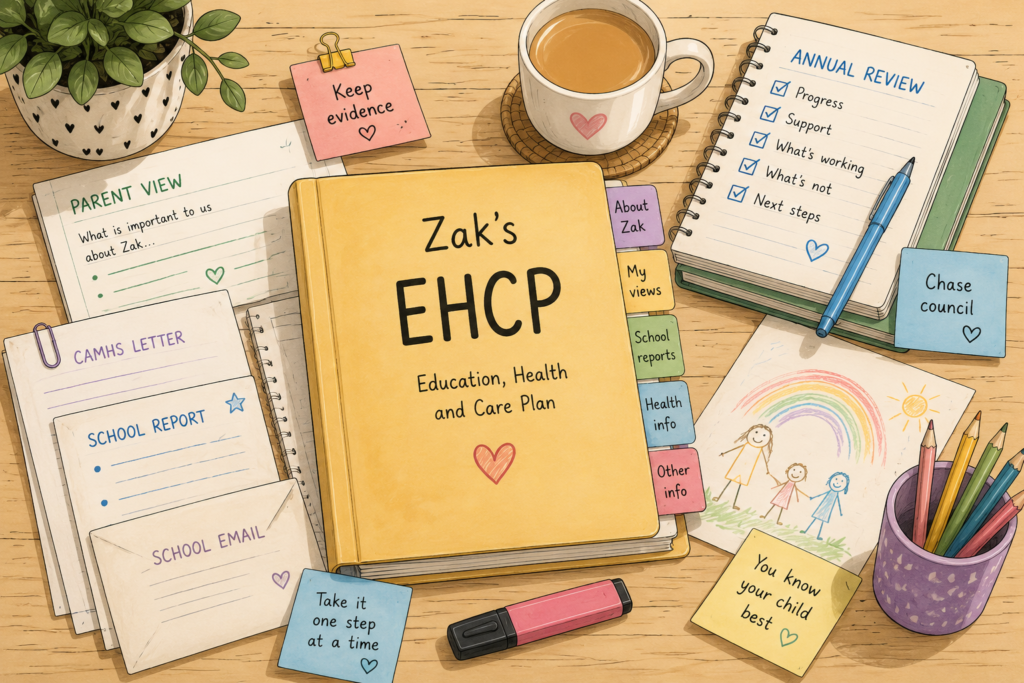
While you’re going through the application it’s also worth getting into the habit of keeping absolutely everything. I don’t mean most things, I genuinely mean everything. Every email, every school report, every letter from a paediatrician, every CAMHS letter if your child has one, reports from outside professionals, behaviour records, meeting notes and anything else that even remotely relates to your child’s needs. I still have a folder full of paperwork now because you never know when you’ll need to refer back to something. It might seem over the top at the time, but you’ll thank yourself later.
The waiting was probably the hardest part for me. I checked my emails every day hoping there’d be an update and every time my phone rang there was a little part of me hoping it was somebody telling us we’d finally made some progress. Sometimes we’d hear something quite quickly and other times it felt like everything had gone completely quiet. There were occasions where I wondered if they’d forgotten about us altogether and I’d end up sending another email just to check where things were up to.
If there’s one thing I’d encourage you to do, it’s don’t be afraid to chase people. I know some parents worry they’ll come across as difficult or pushy, but you’re advocating for your child and nobody is ever going to care about their future as much as you do. As long as you’re polite, there’s absolutely nothing wrong with sending a follow up email or making a phone call if you’ve been waiting longer than expected. Every council works slightly differently, so your experience might not be exactly the same as ours, but I definitely wouldn’t recommend sitting back and assuming somebody else will do the chasing for you.
Most importantly though, don’t lose heart if the process feels exhausting because it probably will at times. There were days where I felt completely fed up with the paperwork and wondered if we’d ever get to the end of it, but looking back now I’m so glad we stuck with it. If I’d listened to that little voice telling me to leave it for another day or hope things would somehow sort themselves out, Zak wouldn’t be where he is now. Sometimes the hardest processes end up making the biggest difference and, for us, applying for an EHCP was definitely one of them.
Who Can Apply For An EHCP?
One of the biggest misconceptions I see is that your child has to have an autism or ADHD diagnosis before you can even think about applying for an EHCP. That’s simply not true. Yes, lots of children who have an EHCP do have diagnoses, but it’s your child’s needs that matter, not the label they’ve been given. Equally, just because your child has autism, ADHD or another diagnosis, it doesn’t automatically mean they’ll get an EHCP either. I know that probably sounds confusing because it certainly confused me at first, but an EHCP is there for children who need more support than a school can reasonably provide through the support they already have in place.
Parents can ask their local authority to carry out an EHCP assessment themselves, so you don’t have to wait for school to suggest it if you genuinely feel your child needs more support. Schools can also request one, as can certain professionals working with your child. In our case it was something both Zak’s school and his dad agreed was the right thing to do, so we were all working towards the same goal from the beginning. I do think that made things a little easier because there wasn’t anybody trying to convince somebody else that Zak needed more help. We all knew he did, it was just a case of getting the right support in place.
If I’m honest, I think one of the hardest parts of the whole process is actually admitting to yourself how much your child struggles. When you’re their parent you adapt your life without even realising you’re doing it. You explain things differently, you prepare them for changes before they happen, you avoid certain situations because you know they’ll be overwhelming and you build little routines around them that eventually become completely normal. You don’t wake up every morning thinking you’re making adjustments because it’s just your everyday life.
Then somebody hands you a form and asks you to explain all of those things and you suddenly realise just how much support your child actually needs. I remember sitting there thinking that some of the things I was writing were just normal family life, but they weren’t really. They were normal for us because we’d been doing them for years.
That’s why I’d always tell parents not to play things down when you’re filling in the forms. I completely understand why people do it because nobody wants to write a list of everything their child finds difficult. I certainly didn’t. As parents we naturally want to talk about how funny they are, how kind they are and all the things they’re brilliant at because that’s how we see them. The problem is that the people making decisions can only work with the information they’re given. If you leave things out because they feel insignificant to you, or because you’ve become so used to them that they don’t seem like a big deal anymore, they don’t get the full picture.
That doesn’t mean exaggerating anything because there’s absolutely no point doing that either. Just be honest. Write about what a normal day actually looks like in your house, what support your child needs at school, what teachers have to put in place and where they genuinely struggle. The more accurate the picture you paint, the easier it is for people to understand why your child might need an EHCP in the first place.
I’d also really recommend working with your child’s school if they’re supportive because they see a completely different side of your child to the one you see at home. We all know children behave differently depending on where they are and who they’re with. School reports, teacher observations and information from professionals all help build a much clearer picture than one parent trying to explain everything on their own.
Finally, try not to think of asking for an EHCP assessment as the finish line because it isn’t. It’s simply asking your local authority to properly assess whether your child needs that level of support. I know that can feel frustrating because by the time you’re making that request you’ve probably spent months, if not years, trying to get people to understand your child, but every step gets you a little bit closer to getting the support they deserve.
How The EHCP Assessment Process Works
Once you’ve asked for an EHCP assessment, the waiting game really begins. If you’re anything like I was, you’ll probably check your emails far more often than you normally would and every time your phone rings you’ll wonder if this is finally the update you’ve been waiting for. Some weeks you’ll feel like things are moving and other weeks it’ll feel like absolutely nothing is happening. That’s completely normal, even though it’s incredibly frustrating when all you want is for somebody to tell you what’s going on.
If the local authority agrees to carry out an assessment, they’ll start gathering information from the people involved in your child’s life. That doesn’t just mean school. Depending on your child’s needs they might also ask for information from healthcare professionals, educational psychologists and any other specialists who work with them. As parents, you’ll also be asked for your views and, although it can feel repetitive at times because you’ll probably find yourself explaining the same things over and over again, it’s really important to take your time with it.
One thing I realised quite quickly was that nobody knows your child better than you do. Teachers see one version of them, health professionals see another and family members might see something completely different again, but you’re the person who sees everything. You see the good days, the bad days and all the bits in between that nobody else gets to see. You’re the one helping them before school when they’re anxious, the one picking up the pieces after a difficult day and the one trying to work out why something that seemed tiny to somebody else completely overwhelmed them. Don’t ever underestimate how valuable your input is because it’s probably one of the most important parts of the whole assessment.
This is also where keeping all of your paperwork becomes really helpful. By the time we started the assessment we’d already built up quite a collection of reports, emails and letters, and although I’d moaned about the amount of paperwork more times than I can count, I was really glad we’d kept it all. It’s amazing how quickly you forget when something happened or exactly what somebody said until you’re looking back through an old report. Having everything in one place meant we weren’t relying on memory alone and we could refer back to things whenever we needed to.
The assessment itself isn’t about trying to catch you out or testing whether you’re a good parent. I know that probably sounds like a strange thing to say, but I think a lot of parents worry about saying the wrong thing or not explaining themselves properly. I definitely overthought some of it. The reality is that the assessment is there to build up a complete picture of your child and understand what support they need. Nobody is expecting you to have all the right words or know the educational terminology. They just need an honest picture of your child’s everyday life and the challenges they face both in and out of school.
Something I’d really encourage you to do throughout the assessment is answer questions based on what life is actually like, not on your child’s very best days. We all have those days where everything seems to go brilliantly and you start thinking maybe things are getting easier, but an assessment needs to reflect your child’s usual experience. If they struggle most mornings before school, say that. If homework regularly ends in tears because they’re completely exhausted after masking all day, include it. If they need support that other children their age don’t need, don’t brush it aside because you’ve become so used to it that it feels normal. A lot of us adapt our lives around our children without even realising we’re doing it and, because of that, it’s easy to forget that what feels normal to us might actually be a significant challenge.
Most importantly, try not to lose confidence in yourself during this stage. There were definitely times where I questioned whether I’d explained something properly or worried that I’d forgotten an important detail. Looking back now I think that’s probably something every parent does. You’re trying to put years of experiences, worries and little everyday challenges into a handful of forms and conversations, so of course you’re going to wonder afterwards whether you should have said something differently. Just remember that you’re the expert when it comes to your child and nobody knows them better than you do.
What Happens During An EHCP Assessment?
By the time you get to the assessment stage, you’ll probably feel like you’ve already answered the same questions about fifty times. I know I certainly did. Every form seemed to ask similar things in slightly different ways and there were moments where I wondered if anybody was actually reading what we’d already sent. Unfortunately that’s just part of the process because everyone involved is building up their own picture of your child.
The assessment itself isn’t one big meeting where everybody sits around a table deciding your child’s future. I think that’s what I imagined before we started because the word assessment makes it sound quite intimidating. In reality it’s much more about gathering information from the different people involved in your child’s life. That usually includes you as parents, school and any professionals who are already supporting your child. Depending on their needs that could include a paediatrician, educational psychologist, speech and language therapist, occupational therapist or other specialists.
One thing I’d really recommend is answering every question as honestly as you can, even if it feels uncomfortable. I know that’s easier said than done because as parents we naturally want to protect our children. Nobody enjoys writing about the things their child struggles with and I definitely found that difficult. You’re so used to celebrating the positives and encouraging them that sitting there listing challenges almost feels wrong. The problem is, if the people carrying out the assessment don’t know about those challenges, they can’t recommend the support your child needs.
Something else that helped me was remembering that I didn’t have to use complicated language or educational jargon. I think it’s very easy to convince yourself that you need to sound professional when you’re filling in forms or talking to people involved in the assessment. You don’t. Nobody knows your child better than you do and sometimes the simplest explanations are the most useful. If your child comes home completely exhausted after masking all day at school then say exactly that. If mornings are stressful because they struggle with change or transitions then explain what actually happens. If they need constant reminders, reassurance or support that other children their age don’t need, write it down. Those everyday things become so normal to us as parents that we sometimes forget they aren’t part of everybody else’s daily life.
One thing I also worried about was saying the wrong thing. I kept thinking I’d forget something important or not explain things properly and that somehow we’d ruin our chances. Looking back now I think I put far too much pressure on myself. The assessment isn’t there to catch you out and it definitely isn’t judging your parenting. It’s there to understand your child and work out whether they need an EHCP. Nobody expects you to have all the answers and nobody expects you to remember every tiny detail from the last few years. Just be honest, take your time and don’t be afraid to ask questions if there’s something you don’t understand because, believe me, there will probably be plenty of things that don’t make much sense the first time you hear them.
How Long Does The EHCP Process Take?
If you’ve found this article because you’ve only just started the EHCP process then you might not like this answer very much, but it’s much better to know what you’re walking into than expect everything to be sorted in a few weeks.
By law, the entire Education, Health and Care Plan (EHCP) process in England must take no more than 20 weeks from the initial request to the final plan.
I can’t tell you exactly how long ours took because, if I’m honest, it all became one long blur of paperwork, emails, reports and waiting. I just remember it being months rather than weeks. Looking back now I couldn’t even tell you exactly when one stage finished and the next one started because there always seemed to be something happening in the background, even if it didn’t feel like it.
Every local authority works slightly differently as well, which makes it even more frustrating because you’ll probably see people online saying their child’s EHCP only took a few months while somebody else says theirs took much longer. Try not to compare your journey too much because it’s very easy to end up worrying that yours is taking longer than everyone else’s when, in reality, there are so many different factors involved.
One thing I definitely wouldn’t recommend is sitting back and assuming people will contact you when they’re ready. We had to send follow up emails every now and then just to check where things were up to and I’d happily do exactly the same again. I know some parents worry they’ll come across as annoying if they keep chasing, but this is your child’s education we’re talking about. As long as you’re polite, there’s absolutely nothing wrong with asking for an update if you’ve been waiting a while.
I also think it’s important to prepare yourself mentally for the fact that there can be long periods where it feels like absolutely nothing is happening. That doesn’t necessarily mean nothing is happening behind the scenes. Reports are being written, professionals are sending information across and decisions are being made, but because you can’t actually see any of that, it can feel like everything has ground to a halt. I remember feeling like our lives were on hold a little bit because we couldn’t really plan for what was coming next until we knew what was happening with the EHCP.
If you’re anything like me you’ll probably spend part of that waiting time second guessing yourself as well. I kept wondering whether I’d filled the forms in properly, whether I’d forgotten something important or whether I should have explained something differently. Looking back now I don’t think that worrying achieved anything other than making me more anxious, but it’s very difficult not to do it when you’re desperate for your child to get the support they need.
As frustrating as the waiting is, try to remember why you’re doing it. At the time it feels like endless paperwork and months of hearing nothing, but you’re working towards something that could make a huge difference to your child’s education. Looking back now, I don’t really remember every email I sent or every time I refreshed my inbox hoping for an update. What I do remember is seeing Zak in the school he’s in now, happy, understood and getting the support he needs. When I think about it like that, the months of waiting don’t seem quite as important anymore.
What Does An EHCP Look Like?
Before we’d been through the process I had this idea in my head that an EHCP would be a couple of pages long with a few notes about Zak and some recommendations for school. I couldn’t have been more wrong. When you finally receive it you’ll probably be surprised by how much information is actually in there because it’s a really detailed document. The first time I looked through ours I remember thinking there was so much to take in that I was going to have to read it several times before any of it really sank in.
Your child’s EHCP is split into different sections and each one covers something different. It talks about their needs, the support they should receive, the outcomes everyone should be working towards and the educational setting that’s considered most appropriate for them. At first glance it can look quite overwhelming because there are lots of different sections and quite a bit of professional terminology, but once you start reading through it slowly it becomes much easier to understand.
When we got ours I found myself reading certain parts and thinking “well that’s not quite how I’d have explained that.” That’s completely normal because nobody knows your child the way you do. Professionals only ever see little snapshots of your child. You see them every single day, so naturally you’ll notice things that other people don’t. If something doesn’t seem right or you think something important has been missed, don’t just assume it has to stay that way. Ask questions and raise your concerns because it’s much easier to get things corrected than spend years wishing you’d said something.
The support written into the EHCP should also be as clear as possible. You don’t want vague statements that could mean almost anything because they’re much harder to hold people accountable to later on. The more specific the document is about the support your child needs, the better. Remember, this isn’t just a report explaining your child’s needs. It’s a legal document that’s there to make sure they actually receive the support that’s been identified.
If you’re reading through your child’s EHCP and some of the sections don’t make much sense, IPSEA’s guide to EHCP sections explains what each part is supposed to contain.
Something else that surprised me was that an EHCP isn’t a document that’s written once and then forgotten about. Before we went through all of this I genuinely thought you’d finally get the EHCP and that would be the end of the process. It isn’t. Your child grows, develops and changes, just like every other child, so their EHCP changes with them. That’s why annual reviews are so important because they give everyone the opportunity to look at what’s working, what’s changed and whether anything needs updating.
Looking back at Zak’s older EHCPs compared to where he is now is actually quite interesting because they tell the story of how much he’s grown. His strengths have become much clearer over the years and so have the things that help him learn best. His current school sees so much more than just his diagnoses. They see a bright, funny teenager who happens to need some extra support, and I think that’s exactly how an EHCP should be used. It shouldn’t reduce your child to a list of difficulties. It should help everyone understand them well enough to give them the best chance of succeeding.
I also think it’s worth remembering that receiving your child’s EHCP isn’t the finish line. I know after months of forms, assessments and waiting it can feel like you’ve finally reached the end, but in reality it’s the beginning of the next stage. Now you’ve got a document that should help shape your child’s education and make sure the right support is in place, which was the whole reason you started the process in the first place.
What Happens After An EHCP Is Approved?
I think this is the bit a lot of parents look forward to because you finally get told your child’s EHCP has been approved and it feels like all those months of paperwork, assessments and waiting have finally paid off. I remember thinking we’d reached the finish line and that everything would suddenly become much easier. In reality, getting the EHCP approved is a huge milestone, but it’s also the beginning of a completely new stage.
The first thing that should happen is the support written into the EHCP starts being put in place. Exactly what that looks like will depend entirely on your child because no two EHCPs are the same. Some children stay in their current school with extra support, while others move to a different setting that’s better suited to their needs. Neither option is better than the other because it’s all about finding the environment where your child has the best chance of learning and feeling happy.
Hopefully you’ll never need it, but if your child isn’t receiving the support written into their EHCP, IPSEA’s advice on enforcing an EHCP explains what your rights are.
For Zak, his EHCP has completely changed the direction of his education. He’s now in a specialist setting for children with additional needs and, looking back, I honestly don’t think he’d be where he is today without it. His classes are much smaller, the staff understand autism and ADHD, they know when he’s overwhelmed rather than assuming he’s just being difficult and there’s much more flexibility in the way they support him. The whole environment is calmer and there’s far less sensory overload for him to deal with every day.
I think one of the biggest changes I’ve noticed isn’t actually anything written on paper, it’s how people see him. At his previous school I often came away from meetings feeling like the conversation was all about what Zak couldn’t do or where he’d struggled. Since moving to his current school it feels completely different. They absolutely recognise the areas he still finds difficult because that support still needs to be there, but they also see everything else. They see how intelligent he is, how funny he is, how kind he is and how talented he is. As a parent that means more than I can really explain because you spend your whole life seeing those things in your child and all you want is for other people to see them too.
That doesn’t mean everything suddenly becomes perfect because it doesn’t. Your child will still have difficult days. There will still be times where school contacts you, things don’t go to plan or new challenges appear as they get older. An EHCP isn’t a magic solution that makes every problem disappear overnight and I think it’s important to be realistic about that. What it does do is give your child a much stronger foundation because the support they’re receiving is based on their individual needs instead of expecting them to fit into a system that doesn’t really work for them.
I’d also say don’t file the EHCP away in a drawer and forget about it once it’s been approved. Keep a copy somewhere you can easily get hold of it because you’ll probably refer back to it more often than you think. I still have all of Zak’s paperwork and although I don’t read through it every week, it’s reassuring knowing I can find it if I need to check something or prepare for a meeting.
Life doesn’t stop once the EHCP arrives either. Your child will keep growing, their confidence will hopefully grow with them and the support they need might change over time as well. That’s completely normal. Some things that were huge challenges when they were younger might become much easier, while new challenges appear as they move through school and eventually start thinking about college or adulthood.
Looking back now, getting Zak’s EHCP approved wasn’t the moment everything suddenly became easy. It was the moment I finally felt like people were starting to listen. After spending so long trying to explain why he needed more support, it felt like somebody was finally saying, “We understand, and we’re going to do something about it.” As a parent that’s an incredibly reassuring feeling because, for the first time in a long time, it felt like we weren’t fighting on our own anymore.
EHCP Annual Reviews Explained
When you first get an EHCP it’s easy to think that’s it. You’ve got the plan, your child is getting support and you can finally stop thinking about paperwork for a while. I definitely thought it would all settle down after that, but an EHCP isn’t something that’s written once and then forgotten about. It needs to be reviewed every year to make sure it’s still meeting your child’s needs because children change so much as they grow up.
We’ve had three annual reviews now and, if I’m honest, I still get anxious every single time one comes around. I don’t think that feeling ever completely goes away because, even though I know it’s there to help Zak, there’s always that little voice in the back of my mind wondering what we’re going to hear. Mum guilt has a funny way of creeping in even when you know you’ve done absolutely everything you can for your child.
The meetings themselves usually last about an hour, although obviously that can vary depending on how much there is to discuss. Before the meeting you’ll normally be asked to complete a parents views form. Ours asks questions like what your child has achieved over the last twelve months, what they’re still finding difficult, whether their needs have changed, how school is helping them make progress, what more could be done and whether there’s anything else you’d like to add. None of the questions are particularly difficult on their own, but I always find myself spending longer on them than I expect because once you actually start thinking about the last year you realise just how much has changed.
The meeting itself is usually attended by the SENCO or another member of staff leading the review, parents and sometimes your child as well if it’s appropriate. Zak came along to our most recent annual review and I actually think it was really valuable for him to be part of the conversation. It gave him the chance to hear people talking about his achievements instead of everything always being discussed without him.
One thing I think people get completely wrong about annual reviews is that they imagine them as some sort of test. I know I did before the first one. I worried that people would be judging my parenting or questioning whether Zak really needed the support he was getting. Looking back now I realise that wasn’t what the meetings were about at all. They’re there to make sure your child’s EHCP still reflects who they are now, not who they were a year ago.
That said, not every annual review has been a positive experience for us. At Zak’s previous school I used to dread them because it often felt like we were walking into a room where everyone was focused on what wasn’t working. They had an autism base and were very proud of it, but if I’m being honest I never felt like they really understood Zak. He’d been suspended there a few times because he couldn’t manage his needs in that environment and I often came away from meetings feeling completely drained. Even though nobody was blaming me, it’s very difficult not to take those conversations personally when they’re about your child.
Our most recent review couldn’t have been more different.
I actually came away smiling, which is something I never thought I’d say after an EHCP meeting. His current school genuinely knows Zak as a person. Yes, they talked about the areas where he still needs support because that’s important, but they also spent so much time talking about everything he’d achieved over the last year. They spoke about how intelligent he is, how funny he is, how kind he is and how much progress he’s made. One thing that really stood out was when they talked about his dexterity. An older EHCP had described his motor skills as adequate, yet now he’s playing the piano, playing the guitar and typing brilliantly. Hearing people recognise those strengths meant such a lot because they’re things we’ve always seen at home and now school sees them too.
I think that’s exactly what an annual review should feel like. It shouldn’t just be an hour spent talking about difficulties. It should be about looking at the whole child, recognising how far they’ve come, talking honestly about what still needs improving and making sure their EHCP grows with them.
If you’ve got your first annual review coming up and you’re feeling nervous, I’d say try not to put too much pressure on yourself. Read through your child’s EHCP beforehand so it’s fresh in your mind, complete the parents’ views form thoroughly instead of rushing through it the night before and take along anything you think might be relevant, whether that’s recent reports, information from outside professionals or anything else that helps explain your child’s needs. Most importantly though, remember that you’re there because you know your child better than anybody else in the room. Your opinion matters just as much as everyone else’s and don’t ever feel like you shouldn’t speak up if there’s something you want included or changed. After all, the whole point of an annual review is to make sure the EHCP continues to work for your child, and nobody understands what they need better than the people who live with them every single day.
Common EHCP Terms Explained
One of the things I found hardest when we first started the EHCP process wasn’t actually the paperwork. It was the language. I remember sitting in meetings or reading letters thinking everybody else seemed to know exactly what all these words meant while I was quietly Googling them when I got home. People throw acronyms around like they’re everyday words and after a while they all just merge into one. If you’re feeling like that, don’t worry because I think every parent probably does at the beginning.
Rather than giving you dictionary definitions that you’ll probably forget five minutes later, I thought I’d explain some of the most common terms the way I wish somebody had explained them to me.
EHCP
This stands for Education Health and Care Plan. It’s the legal document we’ve talked about throughout this guide that explains your child’s needs, the support they should receive and the outcomes everyone should be working towards. If your child has an EHCP, the support written into it isn’t optional. The local authority has a legal duty to make sure it’s provided.
SEN
SEN simply means Special Educational Needs. You’ll see this everywhere because it’s used as a general term for children who need additional support in education. Not every child with SEN has an EHCP because lots of children receive support through school without needing one.
SEND
SEND stands for Special Educational Needs and Disabilities. You’ll often see schools talking about their SEND provision or their SEND team. It’s basically a wider term that includes children with disabilities as well as those with additional educational needs.
SENCO
You’ll probably hear this one a lot. A SENCO is the Special Educational Needs Coordinator in school. They’re usually the person who oversees support for children with additional needs and they’re often your main point of contact if your child is receiving SEN Support or has an EHCP. I always found it much easier having one person to speak to rather than trying to work out who I needed to contact every time something came up.
Educational Psychologist
An Educational Psychologist, sometimes shortened to EP, looks at how your child learns and what support might help them in education. They’ll often carry out assessments and write reports that become part of the EHCP process.
Occupational Therapist
An Occupational Therapist, or OT as you’ll often hear people say, helps children develop the skills they need for everyday life. That could include things like fine motor skills, sensory needs or helping them become more independent.
Speech And Language Therapist
Despite the name, they don’t just help children who struggle to talk. They also support children who find communication difficult in other ways, whether that’s understanding language, expressing themselves or developing social communication skills.
Annual Review
An annual review happens every year once your child has an EHCP. Everyone involved gets together to look at how things are going, what’s changed over the last twelve months and whether the EHCP needs updating. I know they can feel intimidating beforehand because I’ve felt exactly the same, but they’re there to make sure the plan still reflects your child’s needs as they grow.
Local Authority
This is simply your local council. They’re responsible for deciding whether your child needs an EHCP and making sure the support within it is provided. You’ll probably end up emailing them more than you’d ever imagined, so don’t be surprised if their email address becomes one of your most searched contacts.
Reasonable Adjustments
These are changes schools make to help children with additional needs access education more easily. That could be anything from allowing movement breaks to providing extra processing time or adapting the classroom environment. Lots of children receive reasonable adjustments without ever needing an EHCP.
I’m sure there are another hundred terms I could add to this list because education seems to love an acronym, but these are probably the ones you’ll come across most often. The biggest piece of advice I can give you is don’t ever pretend you understand something if you don’t. I used to nod along in meetings sometimes because I didn’t want to look silly, then I’d get home and have to Google half the conversation. Looking back now I’d much rather have asked somebody to explain it there and then because I can almost guarantee I wasn’t the only parent in the room wondering what half of it meant.
Mistakes I Wish I’d Avoided
Hindsight is a wonderful thing, isn’t it? If I could go back to when Zak was three years old and have a conversation with myself, I’d probably save myself quite a few sleepless nights. I don’t think there’s such a thing as being the perfect SEND parent because we’re all just trying to do our best with the information we’ve got at the time, but there are definitely a few things I wish I’d known sooner.
The biggest mistake, without a doubt, was not applying for an EHCP sooner. At the time I kept thinking maybe things would improve, maybe school would be able to manage with the support they already had or maybe we just needed to give it a bit more time. Looking back now I wish we’d started the process earlier because, as you’ve probably realised by now, nothing about an EHCP happens quickly. Even once you’ve decided to apply, there are forms to complete, evidence to gather, professionals to speak to and then months of waiting. Putting it off doesn’t make the process any shorter, it just delays your child getting the support they might need.
Another mistake was assuming I’d remember everything. You tell yourself you’ll definitely remember that conversation with school or you’ll remember what happened during that meeting, but after a few months everything starts blending into one. There are so many phone calls, emails, reports and appointments that it becomes almost impossible to remember who said what and when they said it. That’s why I’m such a big believer in keeping everything now. Every email, every report, every letter, every meeting note and anything else that relates to your child goes into a folder. It might sound a bit excessive, but there were so many times where I found myself digging out something from months earlier because it suddenly became relevant again.
I also think I spent far too much time waiting for other people to do things. That’s probably one of the biggest lessons this whole experience taught me. If you’re waiting for somebody to ring you back, send the email. If you’ve been told you’ll hear something by a certain date and you haven’t, follow it up. If you need an update, ask for one. I know some people hate chasing because they don’t want to feel like they’re bothering anyone, but you’re advocating for your child. Nobody else is going to care about getting things moving as much as you do and that’s completely understandable because this is your child we’re talking about.
Something else I wish I’d understood earlier is that you don’t have to know everything. At the beginning I felt completely out of my depth because everybody seemed to know what they were talking about except me. There were acronyms I’d never heard before, reports full of terminology I didn’t understand and forms asking questions I wasn’t even sure how to answer. I thought I was supposed to somehow become an expert overnight. The reality is you learn as you go. I certainly didn’t know what half the terminology meant when we first started and now I can read through an EHCP without needing to stop every few minutes to Google something.
Probably the biggest thing that helped us was working alongside professionals who genuinely wanted the best for Zak. His SENCO was incredibly helpful throughout the process and having somebody who understood how everything worked made a huge difference. If you’ve got people around you who know the system, lean on them. You don’t have to do absolutely everything on your own and there’s no prize for struggling in silence.
Finally, and this is probably the thing I’d tell myself more than anything else, stop feeling guilty. I spent so much time worrying that I’d somehow caused Zak’s struggles or that I wasn’t doing enough to help him. Looking back now I realise I was putting an impossible amount of pressure on myself. All any of us can do is keep showing up, keep learning and keep fighting for the support our children deserve. That’s exactly what I did, even on the days where I felt exhausted by the whole process, and seeing where Zak is now reminds me that every form, every meeting and every frustrating email was worth it in the end.
My Best Advice For Parents Starting The EHCP Process
If you’ve skipped straight to this section because you’re about to start the EHCP process and you just want somebody to tell you what they wish they’d known at the beginning, these are probably the things I’d tell you if we were sat having a coffee together.
The first one is start as soon as you can. I know it can be tempting to wait and see whether things improve or hope school manages to put enough support in place without an EHCP, and obviously every child is different so only you can decide what’s right for your family, but if people are already suggesting your child might need one then don’t leave it sitting on your to do list for months. The process isn’t quick and the sooner you get started, the sooner your child is moving towards getting the support they might need.
My second piece of advice is don’t give up, even when you feel like you’re getting absolutely nowhere. There were definitely times where I was fed up with the paperwork, fed up with waiting and fed up with checking my emails hoping for an update that never seemed to come. There were days where it felt like we’d been doing the same thing forever and nothing was actually changing. Looking back now I’m so glad we kept going because if we’d given up halfway through, Zak wouldn’t be where he is today.
The third thing I’d say is don’t try and do everything on your own if you don’t have to. We were really fortunate because Zak’s father knew somebody who had experience helping families through the EHCP process and that made such a difference. There were so many forms where I had no idea what they were actually asking and being able to ask somebody for advice saved us a lot of time and probably stopped us making mistakes too. If you’ve got a supportive SENCO, a friend who’s been through the process before or another parent who understands the system, lean on them. There’s absolutely nothing wrong with asking for help.
I’d also tell you to keep every single piece of paperwork you receive, even if you think you’ll never need it again. I know I’ve mentioned this a few times throughout this guide but that’s because it really is that important. Keep school reports, emails, letters from professionals, meeting notes and anything else connected to your child. I still have a folder full of paperwork now and there have been so many occasions where I’ve needed to look back at something from months or even years earlier. It feels excessive while you’re doing it, but you’ll thank yourself later.
Don’t be frightened to chase people either. I know some parents worry they’ll be seen as difficult if they keep emailing or asking for updates, but this is your child’s education. You’re not complaining for the sake of it, you’re making sure things keep moving. Every local authority is different and some are much quicker than others, but if you’ve been told you’ll hear something and that date has come and gone, send the email. The worst that can happen is they tell you they’re still working on it.
One thing I also wish somebody had told me is to stop comparing our journey to everyone else’s. Once you start reading Facebook groups or parenting forums you’ll see people saying their child got an EHCP really quickly, somebody else saying theirs took years, one parent saying they had an amazing experience and another saying it was awful from start to finish. It’s helpful to hear other people’s experiences, but don’t let them convince you that yours will be exactly the same because every child, every school and every local authority is different.
Finally, and this is probably the most important thing I can say, remember why you’re doing all of this. There will be days where you’re completely fed up with forms and meetings. There will probably be moments where you wonder whether it’s really worth all the stress. I know I did. Then I look at Zak now. I look at how settled he is in his current school, how much happier he is, how well he’s doing and how understood he finally feels and I wouldn’t change a single thing. If somebody offered me the chance to skip all the paperwork but take away the support he has now, I’d fill every single form in all over again because that’s how much difference it’s made to his life.
Frequently Asked Questions
Can I apply for an EHCP without a diagnosis?
Yes, you can. This is probably one of the biggest misconceptions around EHCPs because so many people think you need an autism or ADHD diagnosis before you can even start the process. You don’t. An EHCP is based on your child’s needs rather than the diagnosis they’ve been given. If your child clearly needs more support than their school can reasonably provide, you can still ask your local authority to carry out an EHCP assessment.
Does autism automatically qualify for an EHCP?
No, it doesn’t, and neither does ADHD. Every autistic child is different and every child with ADHD is different. Some children receive all the support they need through SEN Support at school, while others need much more specialist help. The decision isn’t based on the diagnosis itself, it’s based on how much support your child needs to access education.
Can I apply for an EHCP myself?
Yes. Parents can request an EHCP assessment themselves, so you don’t have to wait for school to suggest it if you genuinely believe your child needs more support. Schools and other professionals can also request an assessment, but don’t think you have to sit back and wait for somebody else to get the ball rolling.
How long does the EHCP process take?
Every local authority is different so there’s no single answer to this. However, by law, the entire Education, Health and Care Plan (EHCP) process in England must take no more than 20 weeks from the initial request to the final plan. Ours took months and, if I’m honest, it felt even longer because so much of it involved waiting. There were periods where things seemed to move quite quickly and then there were weeks where it felt like nothing was happening at all. My advice would be to prepare yourself for it taking a while, keep hold of all your paperwork and don’t be afraid to politely chase for updates if you’ve not heard anything.
What happens if my EHCP application is refused?
A refusal isn’t necessarily the end of the road, even though it can feel like it at the time. You can ask for the decision to be looked at again and there are appeal processes available if you disagree with the outcome. Hopefully you won’t need to go down that route, but it’s worth remembering that a refusal doesn’t always mean the conversation is over. If your application is refused or you disagree with a decision, IPSEA’s information about appealing EHCP decisions is one of the best free resources available.
Does my child have to attend their annual review?
No. It depends on their age, confidence and whether it’s appropriate for them to be there. Zak came to his most recent annual review and I actually thought it was really positive because he got to hear people talking about everything he’d achieved over the last year. Some children prefer not to attend though and that’s completely fine as well.
Will my child have to move schools if they get an EHCP?
Not necessarily. Lots of children stay exactly where they are and simply receive additional support. Others move to a different setting if that’s considered a better fit for their needs. For Zak, moving to a specialist school has made a huge difference, but every child’s journey will look different and the right setting depends entirely on their individual needs.
Should I keep copies of everything?
Absolutely. I know I probably sound like a broken record because I’ve said it throughout this guide, but keep everything. School reports, emails, letters, meeting notes, reports from professionals and anything else connected to your child. I still have a folder full of paperwork years later and I’ve lost count of the number of times I’ve needed to go back and find something I’d completely forgotten about.
What if I don’t understand all the terminology?
Ask. Seriously, just ask. I spent far too much time nodding along pretending I understood everything because I didn’t want to look silly. Looking back now I wish I’d just said, “Sorry, can you explain what that means?” because I can almost guarantee I wasn’t the only parent wondering what half the acronyms meant. There are so many different terms used throughout the EHCP process that nobody expects you to know them all straight away.
Conclusion
If there’s one thing I’d like you to take away from this guide, it’s that getting an EHCP can feel overwhelming at first, but it really is worth sticking with.
There will be forms that make no sense, emails you’ll have to chase up and days where you wonder if anything is actually happening. I know because I’ve been there. Looking back though, I’d go through every bit of it again if it meant Zak ended up where he is today.
My biggest advice is to trust your instincts. You know your child better than anyone else. If you feel they need more support, don’t be afraid to ask for it. Keep records, ask questions, lean on people you trust and don’t ever feel guilty for advocating for your child.
I really hope this guide has made the EHCP process feel a little less daunting. It might not always be an easy journey, but it can make an incredible difference to your child’s education and, speaking from experience, that’s worth every bit of effort.
Discover more from Miss Pork Pie
Subscribe to get the latest posts sent to your email.


You May Also Like

Kondo and Hinch Your Home: Declutter and Deep Clean With Ease

3 Tips for Dealing With Complex Situations More Effectively