EHCP Timeline Explained – How Long Does The EHCP Process Take?
When you’re first told that your child may need an EHCP, one of the first questions you probably ask is how long it’s all going to take. Unfortunately, that’s also one of the hardest questions to answer because although there are legal deadlines that local authorities are supposed to follow, real life doesn’t always work quite so neatly.
I remember assuming that once we’d started the process, everything would move along fairly quickly. In my head, it was a case of filling in a few forms, attending a meeting or two and then getting an answer. Looking back now, I laugh at how naïve that was. The EHCP process involves assessments, reports, evidence gathering, consultations and plenty of waiting around wondering whether anyone has actually read the paperwork you’ve spent hours putting together.
The good news is that there is an official EHCP timeline. Local authorities aren’t supposed to drag the process out indefinitely and there are specific deadlines they should be working towards. Understanding those deadlines can help you feel a little more in control and make it easier to spot when things aren’t progressing as they should.
In this guide, I’ll walk you through the EHCP timeline from start to finish, explain what happens at each stage and share some of the reasons why delays can happen along the way.
Table of Contents
- What Is The EHCP Timeline?
- How Long Does An EHCP Take From Start To Finish?
- Week 1: Requesting An EHCP Assessment
- What Happens By Week 6 of an EHCP Assessment?
- Gathering Reports And Evidence
- Receiving The Draft EHCP
- The Final EHCP Deadline
- Why EHCP Timelines Sometimes Take Longer
- What Happens If The Local Authority Misses The Deadline?
- Our Own Experience With The EHCP Timeline
- Tips For Surviving The Wait
- Frequently Asked Questions
- Conclusion
What Is The EHCP Timeline?
The EHCP timeline refers to the process a local authority follows when assessing a child for an Education, Health and Care Plan. It starts when a request for an EHC needs assessment is submitted and ends when a final EHCP is issued.
Under the law, the entire process should usually take no more than 20 weeks from the date the local authority receives the request. That sounds fairly straightforward on paper, but those 20 weeks are made up of several different stages, each with their own deadlines and responsibilities.
During that time, the local authority will decide whether your child should be assessed, gather advice from professionals, consider all the evidence and decide whether an EHCP is necessary. If they agree that one is needed, they’ll then produce a draft plan before issuing the final version.
For many parents, the most frustrating part of the timeline is that a lot of it involves waiting. You might spend weeks gathering evidence and filling out forms, only to then find yourself checking your inbox every day for updates that don’t arrive. Knowing roughly what should be happening at each stage can make that waiting feel a little less uncertain.
How Long Does An EHCP Take From Start To Finish?
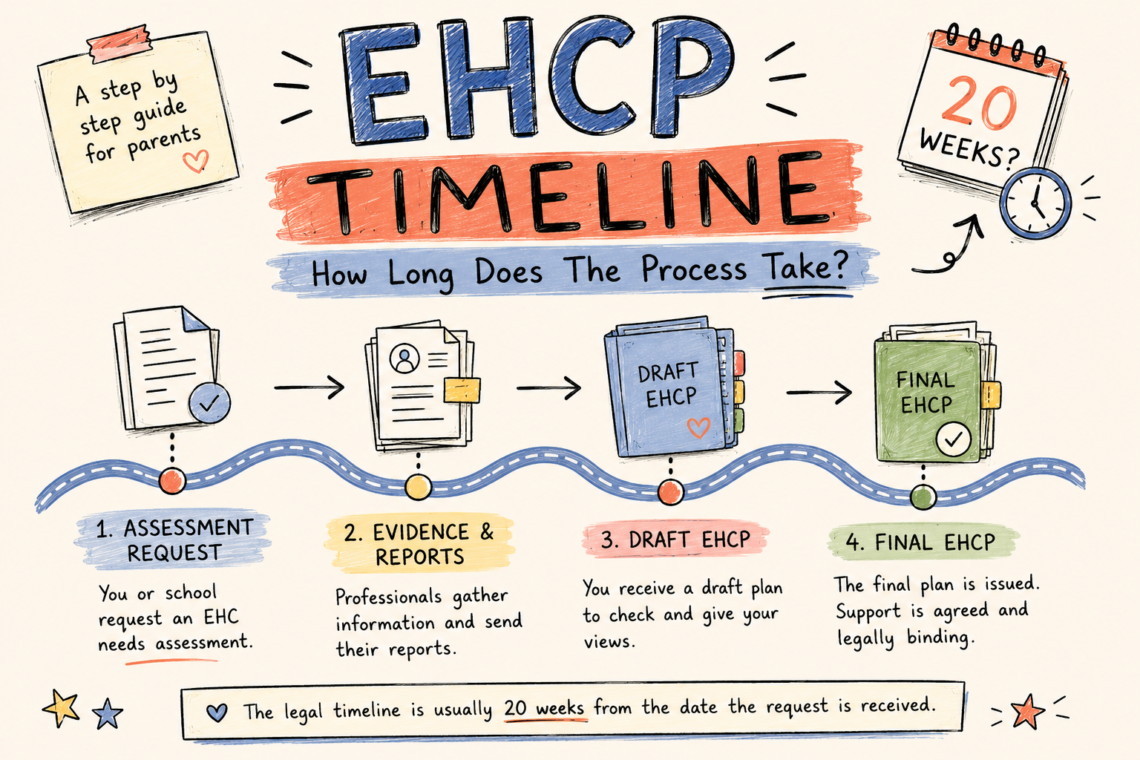
In most cases, the legal EHCP timeline is 20 weeks from the date the local authority receives the request for an EHC needs assessment.
That doesn’t mean you’ll hear absolutely nothing for 20 weeks and then suddenly receive a plan. There are several key milestones along the way and each one has its own deadline.
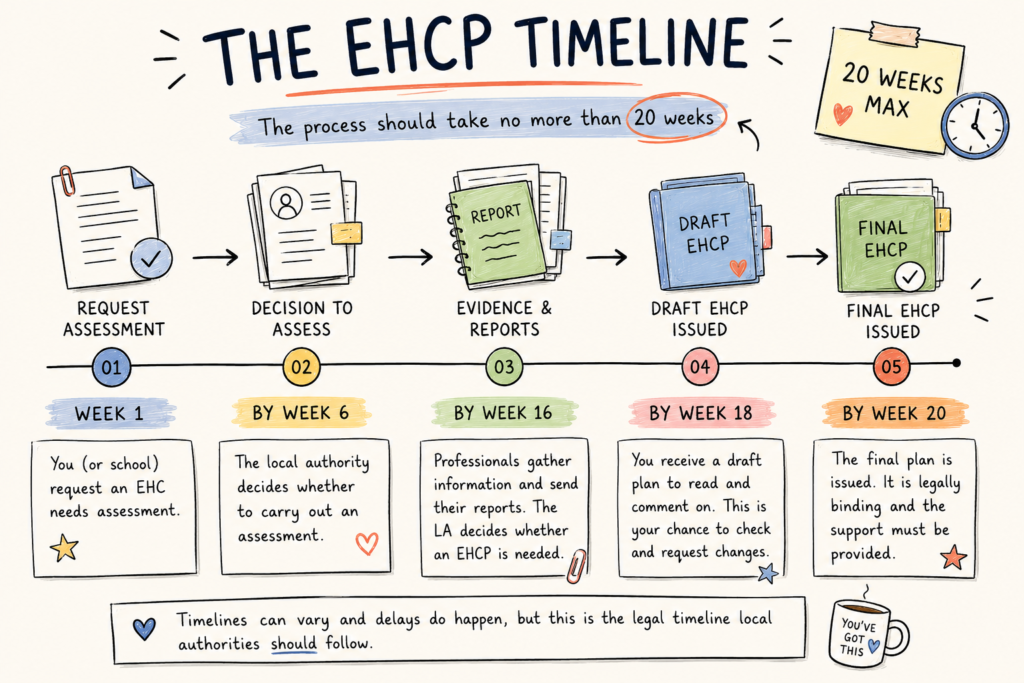
A simplified version looks like this:
- Week 1: Request for assessment submitted
- By Week 6: Local authority decides whether to assess
- By Week 16: Professional advice and reports gathered
- By Week 16: Decision made on whether to issue an EHCP
- By Week 18: Draft EHCP issued
- By Week 20: Final EHCP issued
If everything goes according to plan, that’s the timeline you can expect. Unfortunately, delays do happen. Professional reports may take longer than expected, staff shortages can create backlogs and some local authorities struggle to keep up with demand. While the legal framework is there to protect families, many parents find that reality doesn’t always match the timetable perfectly.
That said, understanding the official timeline gives you something important. It allows you to know when deadlines have passed and when it might be appropriate to start chasing for updates.
Week 1: Requesting An EHCP Assessment
The timeline officially begins when the local authority receives a request for an Education, Health and Care needs assessment.
This request can come from a parent, a school or another professional involved in your child’s care. A lot of parents assume that the school has to make the request, but that’s not actually the case. Parents have the right to request an assessment themselves.
At this stage, you’ll usually be asked to provide information about your child’s needs and any difficulties they’re experiencing in education. Supporting evidence can be extremely helpful. School reports, medical letters, professional assessments and examples of the challenges your child faces day to day can all help paint a clearer picture.
It’s worth keeping copies of absolutely everything. Create a folder, save emails and keep records of dates. It sounds obvious, but when you’re several months into the process and trying to remember who said what and when, you’ll be grateful that you did.
What Happens By Week 6 of an EHCP Assessment?
One of the first major milestones arrives at around Week 6.
By this point, the local authority should decide whether or not they are going to carry out an EHC needs assessment. This isn’t the same thing as deciding whether your child gets an EHCP. It’s simply the decision about whether a full assessment should take place.
Parents are often disappointed if they receive a refusal at this stage, but it’s important to remember that refusals can be challenged. Many families successfully appeal decisions and go on to obtain an EHCP later.
If the local authority agrees to assess, the process moves into the evidence-gathering stage. This is where reports start being requested from professionals involved with your child, and it can often feel like the point where things suddenly become much more serious.
Gathering Reports And Evidence
Once an assessment has been agreed, the local authority will begin collecting information from a range of professionals. Depending on your child’s circumstances, this could include educational psychologists, teachers, speech and language therapists, occupational therapists, doctors and other specialists.
The purpose of these reports is to build a detailed picture of your child’s needs and the support they require. The local authority isn’t just looking at diagnoses. They’re looking at how those needs affect your child’s ability to access education and what adjustments or support might be necessary.
This stage can feel frustratingly slow because you’re often waiting for multiple professionals to complete reports. Some families find that this is where the timeline starts to feel less like a straight road and more like sitting in traffic wondering why nobody is moving.
The important thing to remember is that these reports often form the foundation of the final plan. While waiting is difficult, thorough evidence can make a significant difference later on.
Receiving The Draft EHCP
If the local authority decides that your child needs an EHCP, you’ll usually receive a draft version before the final plan is issued. This normally happens around Week 18 of the process, although exact timings can vary.
The draft EHCP is your opportunity to check everything carefully before it becomes the final document. It’s tempting to skim through it, especially after months of forms, reports and waiting, but this is probably one of the most important stages in the entire process.
Read every section. Then read it again.
Check that your child’s needs have been described accurately and make sure the support listed is specific. One thing many parents learn very quickly is that vague wording can cause problems later. A statement saying a child will receive support “when necessary” is very different from a statement saying they will receive a specific number of hours of support each week.
This is also the stage where you’ll be able to express a preference for a school or educational setting. If you feel changes need to be made, don’t be afraid to raise them. Once the final EHCP is issued, making amendments becomes a much bigger process.
The Final EHCP Deadline
The final EHCP should normally be issued by Week 20.
This is the point where the document becomes legally binding. That’s one of the reasons EHCPs are so important. The support written into the plan isn’t simply a list of recommendations or good intentions. The local authority has legal responsibilities regarding the provision outlined in the plan.
For many parents, receiving the final EHCP feels like reaching the finish line after months of paperwork and uncertainty. In reality, it’s often the beginning of a new stage rather than the end of the journey.
Once the plan is in place, attention usually turns towards making sure the support is actually delivered and that the educational setting can meet your child’s needs. The annual review process will eventually become part of that picture too, but hopefully by this stage you’ll feel as though some of the uncertainty has finally been replaced with a clearer plan.
Why EHCP Timelines Sometimes Take Longer
If you’ve spent any time in SEND parent groups, you’ve probably seen plenty of discussions about delays. Unfortunately, although the legal timeline is clear, delays are not uncommon.
There can be lots of reasons for this. Local authorities may be dealing with large numbers of applications, educational psychologists can have long waiting lists and some services simply don’t have enough staff to keep up with demand.
Parents often find themselves chasing updates, requesting information and trying to work out where their application currently sits in the process. It can be exhausting, particularly when you’re already supporting a child who may be struggling in school.
One thing I’ve learned from speaking to other parents is that delays are often easier to deal with when you understand what should be happening. If you know the official timeline, it’s much easier to recognise when a deadline has passed and when it might be time to ask questions.
What Happens If The Local Authority Misses The Deadline?
This is another question that comes up a lot.
The short answer is that local authorities are expected to follow the legal timeline. If deadlines are missed, parents don’t simply have to sit quietly and accept it.
The first step is usually to contact the local authority and ask for an update. Sometimes there is a genuine explanation and a revised timeframe can be provided. If delays continue or communication is poor, there are organisations such as IPSEA that provide advice and support to families navigating the SEND system.
While nobody enjoys having to chase progress, it’s important to remember that you’re advocating for your child. Asking questions about missed deadlines isn’t being difficult. It’s making sure the process is moving forward.
Our Own Experience With The EHCP Timeline
One thing I wish somebody had told me at the start is that the emotional side of the process can sometimes feel harder than the paperwork itself.
The forms take time and gathering evidence can be tedious, but what I found most difficult was the waiting. There are long stretches where you don’t feel as though anything is happening, even though reports are being gathered behind the scenes and decisions are being considered.
When you’re watching your child struggle, every week feels longer than it probably is. You want answers. You want support in place. You want to know what comes next.
Looking back, understanding the timeline would have helped me worry less. Not because the process would have moved any faster, but because I would have had a clearer idea of what stage we were actually at and what should happen next.
Tips For Surviving The Wait
The EHCP process isn’t known for being quick, so finding ways to stay organised can make a huge difference.
Keep copies of every letter, report and email. Create a folder, either physical or digital, and keep everything together. You’ll almost certainly need to refer back to information later.
Make a note of important dates. Knowing when requests were submitted and when deadlines should fall can help you keep track of progress.
Try not to panic if you don’t hear anything for a short period. Some stages naturally involve waiting while professionals prepare reports and recommendations.
Most importantly, don’t be afraid to ask questions. If you’re unsure about what stage the process has reached, contact the local authority and ask for an update. You’re entitled to understand what’s happening.
Frequently Asked Questions
How long does an EHCP take?
The legal EHCP timeline is usually 20 weeks from the date the local authority receives a request for an EHC needs assessment. This includes assessment, evidence gathering, decision making, the draft plan and the final EHCP.
What is the legal EHCP timeline?
The process should normally follow this schedule:
- Week 1: Request received
- By Week 6: Decision whether to assess
- By Week 16: Reports gathered and decision made
- By Week 18: Draft EHCP issued
- By Week 20: Final EHCP issued
Can an EHCP take longer than 20 weeks?
Unfortunately, yes. Although the legal timeframe is 20 weeks, delays can happen due to staff shortages, waiting lists and administrative backlogs. If deadlines are missed, parents can request updates and seek advice if necessary.
Why is my EHCP taking so long?
Delays can occur when professional reports take longer than expected, specialist services have waiting lists or local authorities are dealing with a high number of applications. Understanding the official timeline can help you identify when delays have occurred.
What happens after the final EHCP is issued?
Once the final EHCP is issued, the support outlined in the plan becomes legally binding. The focus then shifts to making sure the support is delivered and that your child’s educational setting can meet their needs.
Can I complain if EHCP deadlines are missed?
Yes. Parents can contact the local authority to request updates and explanations. If necessary, organisations such as IPSEA can provide guidance on the options available when legal deadlines are not being met.
Conclusion
If there’s one thing I’d like parents to take away from this article, it’s that the EHCP process often feels much longer than it looks on paper. Twenty weeks doesn’t sound too bad when you first hear it, but when you’re waiting for decisions that could have a huge impact on your child’s education, every stage can feel painfully slow.
Understanding the timeline won’t necessarily make the waiting any easier, but it does make the process less mysterious. You’ll know what should be happening, when decisions should be made and when it’s reasonable to start chasing for updates.
Most importantly, try to remember that delays and paperwork don’t define the outcome. The goal isn’t simply to get through the process as quickly as possible. The goal is to make sure your child gets the support they need to thrive in education. If the journey feels frustrating at times, you’re certainly not alone.
Discover more from Miss Pork Pie
Subscribe to get the latest posts sent to your email.


You May Also Like

How to Venture Towards New Health Kicks

4 Tips For Saving Up For Big Family Purchases